


Is Your Teen or Young Adult Incapable of Explaining Their Own Behavior? How Journey Home & Higher Grounds Mgmt’s Award-Winning Behavioral Intervention Approach Uses Behavior Chains to Find the Answers
- Tynan Mason at Higher Grounds Management

- Apr 17
- 5 min read
Join us for our new digital detox and wellness retreat for youth ages 10-12, teens, and young adults at The Ranch.
Discover the step-by-step strategies to restore connection and establish healthy digital boundaries in your home with our interactive Family Playbook.
Want to monitor and limit your teen's screen time? Follow our free set-up guide for the Qustodio App.
Get access to our exclusive e-course for children, teens, and young adults struggling with screen addiction: The 3 to 7 Day Challenge.
PuraVida Therapy: Gratitude & Wellness Retreats for Teens & Young Adults. Surf 🏄 + Skate 🛹 + Snow 🏂
Contact a behavioral consultant team that is proven to get results for you and your family, no matter which city and state you live in, with Higher Grounds Mgmt.
Written by Tynan Mason of Higher Grounds Management
The "I Don't Know" Phenomenon
Every parent of a struggling teen knows the frustration of the post-incident interrogation. Your child punches a wall, throws a phone, or gets suspended for defiance. You ask the logical question: "Why did you do that?" The answer is almost always a mumbled, "I don't know."
Here is the scary truth: they are telling the truth. In the moment of high stress or high dopamine craving, their thinking brain (the prefrontal cortex) was offline. They were operating entirely on impulse and emotion. They literally do not know the steps that led them from point A to point B because they were on autopilot.
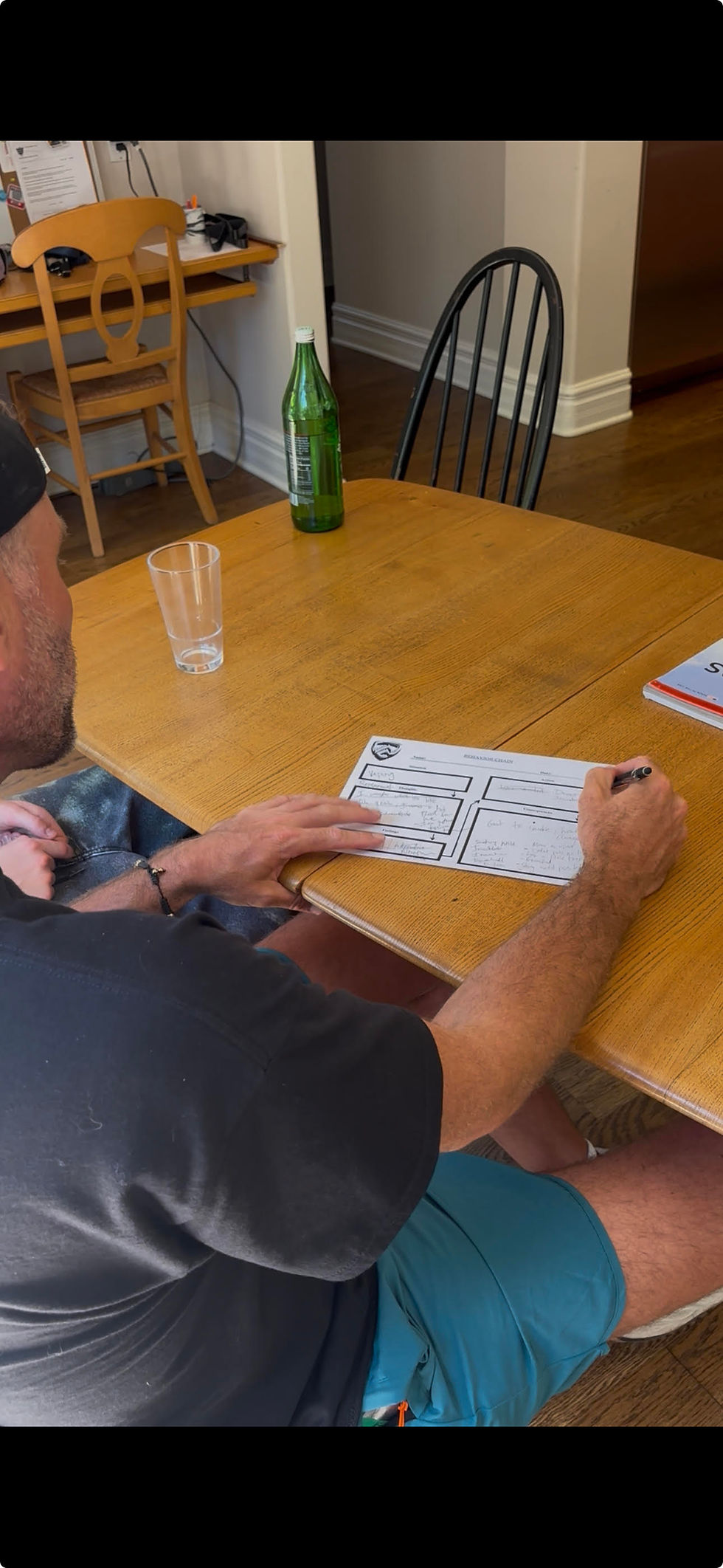
To break this cycle of impulsivity, we must force the brain to slow down. We must teach them to map the territory of their own mind. At Higher Grounds Management, we use a powerful cognitive behavioral tool called the "Behavior Chain." It is the process of putting a mistake in slow motion to understand exactly how it happened, and how to stop it next time.
Deconstructing the Chain
A Behavior Chain is an exercise where we ask the teen to dissect a specific situation—a relapse into screen use, an argument, a failure at school—into four distinct links: Thoughts, Feelings, Actions, and Consequences.
Most teens conflate these. They think "I felt angry so I threw the phone" is a complete sentence. But they skipped the critical steps. What was the trigger? What was the specific thought ("My mom is trying to control me") that led to the feeling of anger? What was the action? And most importantly, what was the consequence?
By writing this out, the teen sees the mechanics of their own behavior. They realize that the action (throwing the phone) was not inevitable. It was the result of a sequence. If they can identify the trigger or change the thought, they can change the outcome.
Strengthening the Frontal Lobe
This practice is not just paperwork; it is a gym workout for the brain. Neuroscience tells us that the prefrontal cortex, the CEO of the brain responsible for planning, logic, and consequence analysis—is not fully developed until the mid-20s. Conversely, the amygdala, the emotional center, is fully active in teens.
This mismatch causes impulsivity. The car has a Ferrari engine (emotions) and bicycle brakes (logic).
When a teen completes a Behavior Chain, they are artificially engaging their frontal lobe. They are forcing their brain to trace the line from cause to effect. Repeatedly doing this exercise builds neural pathways. It strengthens the connection between the emotional centers and the logic centers. Over time, this "hindsight" analysis begins to turn into "foresight."
From Autopilot to Pause
The goal of the Behavior Chain is to move from reacting to responding. Initially, we use this tool to look at the past. We analyze the wreckage after the crash. "Okay, you relapsed. Let's look at the chain. You were bored (Feeling). You thought 'One video won't hurt' (Thought). You opened the app (Action). You lost four hours and failed your test (Consequence)."
After enough repetitions, a magical shift occurs. The teen begins to recognize the chain while it is happening.
They feel the boredom. They hear the thought "One video won't hurt." And suddenly, their brain flags it. "Wait, I recognize this chain. I know where this leads." This creates a pause. In that pause, they have the power to make a different choice. They learn to play the tape forward and see the consequence before they take the action.
Connecting Feelings to Consequences
One of the profound benefits of this practice is emotional literacy. Many young men, in particular, struggle to identify feelings beyond "good," "bad," or "mad."
Through Behavior Chains, they learn that feelings drive actions. If they can identify that they are feeling "lonely" or "insecure" rather than just "angry," they can address the root cause.
Furthermore, they confront the reality of consequences. Screen addiction thrives on the denial of consequences. The addict focuses on the immediate pleasure. The Behavior Chain forces them to write down the long-term pain: loss of trust, loss of privileges, academic failure. You cannot ignore the cost when you have to write it out in black and white.
The Parallel Process: Mapping Your Own Meltdowns
Parents, the "Parallel Process" dictates that you are not exempt from this work. How often do you react impulsively to your teen?
Trigger: Teen rolls eyes.
Thought: "He is so disrespectful, I am failing as a parent."
Feeling: Shame and Rage.
Action: Scream and take away the car keys aggressively.
Consequence: Teen withdraws further, relationship is damaged.
If you want your teen to manage their impulsivity, you must manage yours. Use the Behavior Chain tool on yourself. Share your findings with your teen. "I realized that when I yelled yesterday, it was because I was feeling scared, not because you were doing something terrible." This vulnerability models the exact type of self-reflection you are asking them to do.
Slowing Down at The Ranch
In the hyper-speed world of digital media, there is rarely time to reflect. One TikTok video leads to the next in seconds. There is no gap for a Behavior Chain.
This is why The Ranch is a critical intervention. In Creston, California, life moves at the speed of nature. When a teen is working with a horse, the feedback is immediate, but the pace is grounded.
If a teen acts impulsively around a 1,000-pound animal, the consequence is instant (the horse moves away or refuses to cooperate). We use these moments to build Behavior Chains in real-time. "What just happened? What were you thinking right before the horse pulled away? What was your energy?" This experiential learning cements the concept far better than a worksheet alone.
Thinking Ahead to Get Ahead
The 3 to 7 Day Challenge incorporates these reflective practices to break the trance of screen addiction. We want to equip your teen with the ability to predict the future of their own life.
A teen who understands Behavior Chains is a teen who can navigate peer pressure. They can see the chain: "If I go to this party with these people (Action), I know I will feel pressured (Feeling), and the consequence might be an arrest."
By teaching them to analyze the links in the chain, we give them the key to unlock their own potential. We give them the brakes they need to steer their life safely.
Higher Grounds Management works with families nationwide and welcomes out-of-state parents who are ready for a different approach.
Breakthroughs happen when environment, accountability, and support align.
If you’re in Manhattan Beach, Hermosa Beach, Redondo Beach, El Segundo, Torrance, Rolling Hills, Rancho Palos Verdes, Newport Beach, Corona Del Mar, or anywhere in Orange County, Higher Grounds Management is here to help. We also offer virtual support and therapy to families nationwide.
Join us for our new digital detox and wellness retreat for youth ages 10-12, teens, and young adults at The Ranch.
Want to monitor and limit your teen's screen time? Follow our free set-up guide for the Qustodio App.
Get access to our exclusive e-course for children, teens, and young adults struggling with screen addiction: The 3 to 7 Day Challenge.
We’re here to help, in your home or virtually. Contact us today to get started.
Written by Tynan Mason of Higher Grounds Management.



Comments